Before It Was North Dallas: Part Ten: Before NorthPark Was NorthPark
Before It Was North Dallas: Roads, Rails and the Shape of the Suburbs
Part Ten: Before NorthPark Was NorthPark
Before NorthPark became one of Dallas’ most recognizable shopping and cultural destinations, it was a cotton field.
That is hard to picture now.
Today, NorthPark Center is polished, curated and unmistakably Dallas. It is where people go to shop, wander, meet friends, see art, take holiday photos, grab lunch, escape the heat and pretend they are “just looking” when we all know that is how trouble starts.
But before the department stores, fountains, sculptures, luxury boutiques and holiday displays, the land belonged to a much older North Dallas story.
It was part of the Caruth landscape.
And when Raymond Nasher saw it, he imagined something very different from a typical shopping center.
A Cotton Field on the Edge of Dallas
In the early 1960s, real estate developer and art collector Raymond Nasher leased a 97-acre cotton field from Will Caruth. The land sat across from the Caruth family’s historic farmhouse and 1870s mansion, connecting NorthPark directly to the agricultural and family land history that shaped much of North Dallas.
That detail matters.
NorthPark was not built in the middle of what we now think of as fully developed Dallas. It was built at a moment when North Dallas was still expanding outward, when former farmland was being transformed into neighborhoods, roads, schools, businesses and shopping destinations.
Like so many stories in this series, NorthPark begins with land.
Land that had once been rural.
Land connected to one of Dallas’ most recognizable family names.
Land that was about to become something entirely new.
Raymond Nasher Saw More Than Retail
NorthPark opened in 1965 and quickly became one of Dallas’ defining modern retail spaces. The Cultural Landscape Foundation describes NorthPark as a place that has long been considered an “art museum inside a shopping center.”
That phrase explains why NorthPark feels different.
Raymond and Patsy Nasher did not treat art as an afterthought. They made it part of the experience. Art, architecture, landscaping and retail were designed to work together, creating a space that felt calm, elegant and memorable instead of purely commercial.
NorthPark was not just asking people to shop.
It was asking them to look.
To pause.
To notice scale, light, sculpture, landscaping and design.
That was a bold idea for a suburban shopping center in the 1960s.
Modernism, Light and Restraint
NorthPark’s architecture is part of why it has aged so differently from many other malls.
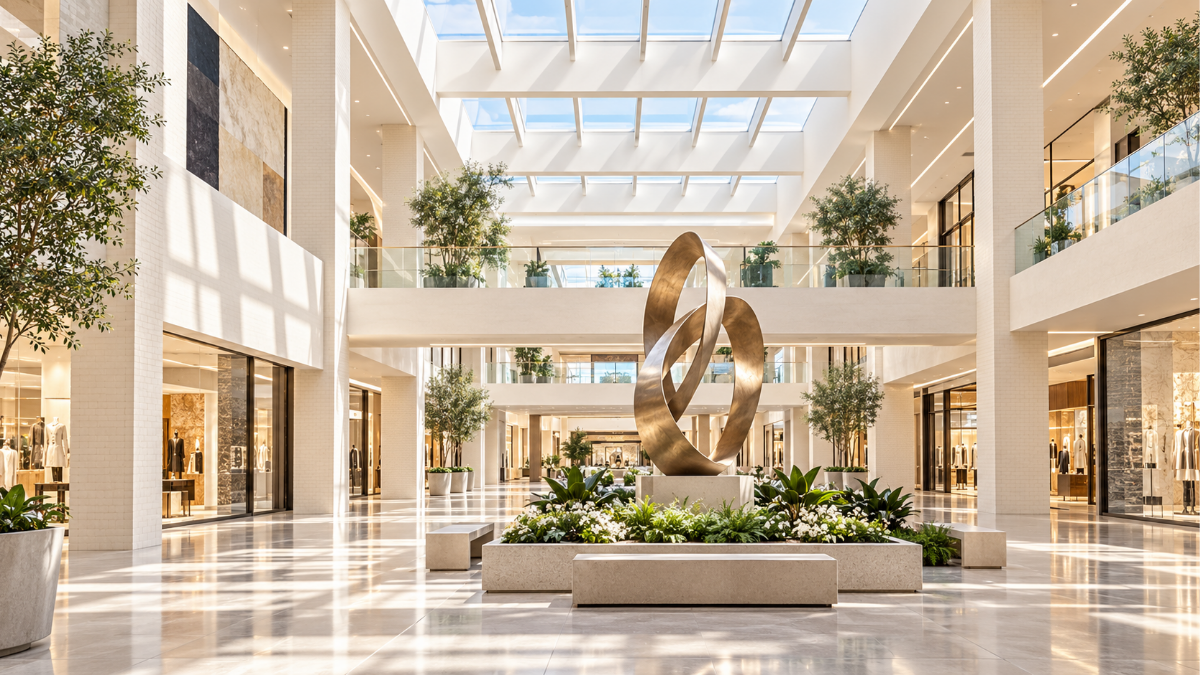
The original center was designed with clean lines, generous circulation, white brick, controlled natural light and a restrained modernist feel. The Society of Architectural Historians identifies the original 1965 design with Harrell and Hamilton Architects, with later expansions in 1975 and 2006 by OMNIPLAN.
That restraint is important.
NorthPark does not overwhelm visitors with visual noise in the way many retail centers do. Its design gives the art room to breathe. The wide corridors, skylights, courtyards and landscaping create a sense of openness that feels more like a civic or cultural space than a conventional mall.
That is part of the genius of the place.
It feels elevated without trying too hard.
Very Dallas, honestly.
The Art Was Never Just Decoration
NorthPark’s art collection is one of the biggest reasons the center became more than a shopping destination.
NorthPark describes its collection of 20th and 21st century art as internationally acclaimed, with works from the Nasher family’s collection and additional pieces on loan from the Nasher Sculpture Center. The center also offers a self-guided art experience for visitors.
That makes NorthPark unusual.
You can go there for shoes and end up standing in front of major contemporary art.
You can meet someone for lunch and walk past sculpture that would not feel out of place in a museum.
You can bring a child to see the ducks, the fountains or Santa, and accidentally introduce them to public art along the way.
There is something very special about art being part of everyday life instead of locked behind a formal museum visit.
NorthPark made that normal for generations of Dallas residents.
The Caruth Connection Comes Full Circle
This post also connects back to Part Five of this series, the story of the Caruth Farm and Dr. M.C. Cooper.
The Caruth name is still visible across North Dallas in street names, neighborhoods, parks and institutions. NorthPark is another part of that same land story. It shows how former agricultural land became one of the region’s most valuable and recognizable commercial destinations.
That transformation is one of the major themes of North Dallas history.
Farmland became neighborhoods.
Rail lines became commuter routes.
Roads became commercial corridors.
Old family land became modern Dallas landmarks.
NorthPark sits right in the middle of that evolution.
More Than a Mall
Calling NorthPark “a mall” has always felt a little incomplete.
Yes, it is a shopping center.
But it is also a design statement, an art space, a community gathering place and a Dallas tradition.
Visit Dallas describes NorthPark as a shopping destination known for luxury retail, internationally acclaimed art, award-winning architecture, landscaping, CenterPark and its movie theater.
That mix is the whole point.
NorthPark became successful because it gave people more than stores. It created an experience. It gave Dallas a place that felt both commercial and cultural, suburban and sophisticated, practical and beautiful.
That is why it has remained relevant while so many traditional malls across the country have struggled.
NorthPark understood something important early on:
People may come to buy something, but they return because of how a place feels.
How NorthPark Shaped North Dallas
NorthPark also helped define what North Dallas could become.
Its location near major roadways made it accessible to a growing suburban population. Its scale matched the region’s postwar growth. Its tenant mix attracted shoppers from across Dallas and beyond. Its art and architecture gave it cultural weight.
In other words, NorthPark was not simply a result of North Dallas growth.
It helped shape that growth.
It gave the area a destination.
It reinforced the value of nearby neighborhoods.
It made the intersection of retail, design, transportation and affluence visible in one place.
For anyone who loves real estate, architecture or local history, NorthPark is a perfect case study in how land use can change the identity of an entire area.
The Real Estate Lesson Hidden in the Courtyard
There is a reason this story belongs in a chapter about roads, rails and the shape of the suburbs.
NorthPark was built where it was because location mattered.
Access mattered.
Growth patterns mattered.
The surrounding neighborhoods mattered.
The Caruth land story mattered.
The design choices mattered too.
Real estate is not just about what gets built. It is about where it gets built, why it gets built there, and what kind of experience it creates once people arrive.
NorthPark worked because it understood all of those things at once.
It took a former cotton field and turned it into a destination that still feels distinctive more than half a century later.
That does not happen by accident.
Before It Was North Dallas
Before NorthPark was NorthPark, it was farmland.
Before the art collection, it was open land tied to the Caruth family’s North Dallas legacy.
Before the luxury stores and restaurants, it was a bold bet that a shopping center could be more than a place to buy things.
And before North Dallas became the version we know today, places like NorthPark helped define what the area could become.
That is the thread running through this chapter of Before It Was North Dallas.
A railroad helped create Richardson.
The Interurban connected early suburbs to Dallas.
The Red Brick Road strengthened Richardson’s automobile connection.
Fire reshaped Downtown Plano.
And a cotton field became NorthPark.
Different stories.
Same bigger lesson.
Land changes when access, timing, vision and investment come together.
What piece of North Dallas history do you think deserves to be remembered?
Next in the series: We will begin a new chapter focused on communities, preservation and the places that help us understand what North Dallas chose to keep, starting with Plano’s historic Douglass Community.
💻 Keep up with the whole Before It Was North Dallas series here: Before It Was North Dallas
Here is your local-history field trip: next time you are at NorthPark, do not just make a beeline for the store you came to visit. Walk slower. Look at the art. Notice the light, the courtyards, the landscaping and the way the space feels different from almost every other shopping center. Then casually mention to whoever you are with that this all started as a cotton field. Congratulations, you are now the fun history person in the group.
As a Dallas native and longtime North Dallas REALTOR®, I love helping people understand the stories behind the places we live, shop, gather and invest. If you are thinking about buying, selling or simply learning more about Richardson, Plano, Addison or North Dallas, reach out anytime. I am always happy to talk homes, history, land and the details that make each community feel like itself.

Kelly Reber, REALTOR® | eXp Realty LLC | Texas License #0483312
Licensed since 2000
Dallas | Richardson | Plano | Addison | North Dallas
Dallas native Kelly Reber has been helping buyers, sellers, relocating clients, and investors navigate North Dallas real estate since 2000. She combines deep local knowledge, data-driven strategy, and straightforward advice to help clients make confident real estate decisions.
Learn more: About Me
Categories
Recent Posts