Neighborhoods to Watch | Chapter Two Part 8: Lakewood
Neighborhoods to Watch | Chapter Two: Neighborhoods That Still Feel Like Old Dallas
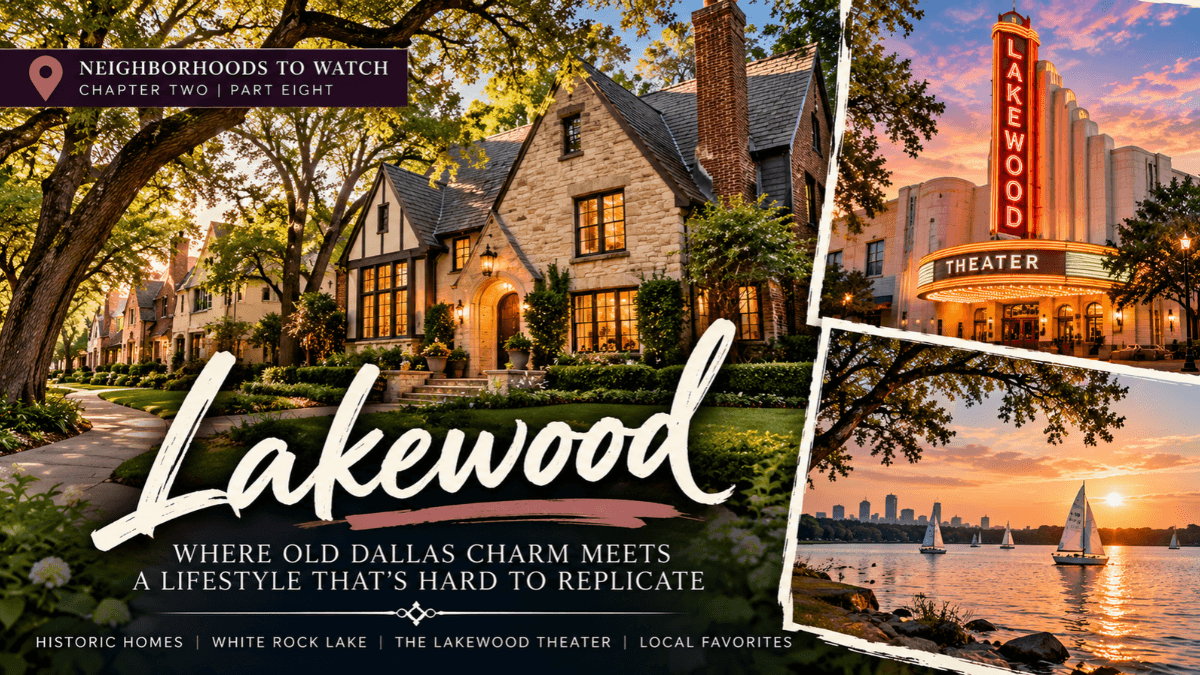
Part Eight: Lakewood: Where Old Dallas Charm Meets a Lifestyle That's Hard to Replicate
Historic architecture, towering trees, a beloved neighborhood shopping district and White Rock Lake just around the corner. Lakewood has managed to hold on to something special while Dallas has grown all around it.
There are some Dallas neighborhoods where you can almost feel the city's history as you drive through.
Lakewood is one of them.
The streets wind beneath mature trees. Beautiful old Tudor homes sit alongside Spanish Revival houses, charming cottages and newer custom homes. And just when you think you've found your favorite street, another one comes along.
But what I find most interesting about Lakewood isn't simply its architecture or proximity to White Rock Lake.
It's how much of its original identity the neighborhood has managed to preserve.
Dallas has changed dramatically over the past century. Shopping centers have come and gone, neighborhoods have been redeveloped, and entire areas have been transformed.
Yet Lakewood still feels like a neighborhood built around the idea of living, rather than simply getting from one place to another.
And there's a fascinating story behind how it got that way.
Before Lakewood Was Lakewood
To understand Lakewood, we have to go back to a time when much of East Dallas was still developing.
White Rock Lake was completed in 1911 as a municipal water supply, years before it became the recreational destination Dallas residents know today.
The surrounding countryside began attracting residential development, particularly as Dallas expanded outward during the early 20th century.
Lakewood Country Club was established in 1912, and residential development followed in the years and decades that came afterward.
By the 1920s and 1930s, Lakewood was taking shape as an attractive residential community with winding streets, substantial homes and easy access to the growing city.
It offered something that was becoming increasingly appealing to Dallas families: a quieter neighborhood setting without being too far from downtown.
Sound familiar?
More than a hundred years later, that combination remains one of Lakewood's biggest attractions.
The Architecture: A Neighborhood That Refused to Look Ordinary
One of my favorite things about Lakewood is the variety of its homes.
Unlike neighborhoods where nearly every house follows the same floor plan or architectural formula, Lakewood has a wonderful mix of styles.
You'll find:
-
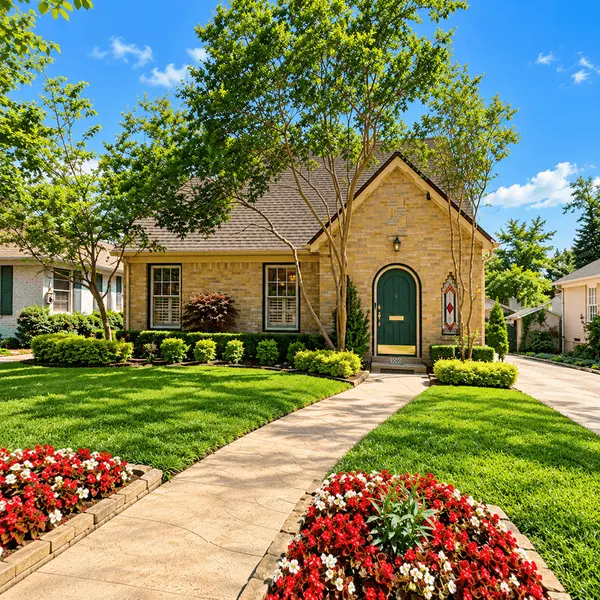
Tudor Revival homes, with steep rooflines, decorative brickwork and distinctive entryways.
-
Spanish Revival and Mediterranean-inspired homes, with stucco, arches, decorative tile and romantic architectural details.
-
Traditional brick cottages, many dating to the 1920s, 1930s and 1940s.
-
Larger historic estates, some with unusual craftsmanship and one-of-a-kind features.
-
Newer custom homes, reflecting how the neighborhood has continued to evolve.
And then there are the homes designed by Clifford D. Hutsell.
The Architect Who Helped Give Lakewood Its Personality
Hutsell was a Dallas builder and designer whose distinctive houses helped shape the architectural character of Lakewood.
His work often featured Spanish-inspired details, colorful tile roofs, textured masonry, unusual window treatments and dramatic entrances.
These weren't houses designed to disappear into the background.
They were full of personality.
Some of his Lakewood homes remain among the neighborhood's most recognizable architectural treasures.
It's a reminder that neighborhoods develop character one building at a time.
And once that character is lost, recreating it isn't nearly as simple as building something new.
The Lakewood Theater: An East Dallas Landmark Since 1938
Every great neighborhood seems to have a landmark that tells you exactly where you are.
For Lakewood, it's hard to beat the Lakewood Theater.
The theater opened in 1938, when going to the movies was an event and neighborhood theaters were important gathering places.
Its dramatic Art Deco architecture and towering neon sign quickly became part of the Lakewood identity.
And here's something you might not know.
The theater's interior included murals by Dallas artist Perry Nichols and sculptures by José Martin, whose work was also associated with the 1936 Texas Centennial.
This wasn't simply a place to watch a movie.
It was an architectural experience.
Over the decades, the theater faced changing entertainment habits, closures and questions about its future.
But its distinctive exterior survived, and the building received Dallas Landmark designation.
Today, the historic sign remains one of the most recognizable visual symbols of East Dallas.
I love that.
Because sometimes preserving a building isn't just about saving the structure.
It's about keeping a familiar piece of the neighborhood's identity.
The Shopping Center That Almost Changed Everything
Here's one of the more interesting chapters in Lakewood's history.
The Lakewood Shopping Center began developing in the 1930s, giving residents a neighborhood commercial destination rather than requiring every errand to become a trip downtown.
It was designed around the idea of a local shopping village, with shops, services and entertainment close to home.
But by the 1960s and 1970s, the center was facing decline.
And the proposed solutions weren't universally popular.
The Abrams Bypass Controversy
City planners explored major changes to traffic circulation and the shopping district.
The debate became known as the Abrams Bypass War.
Plans involved rerouting traffic, changing streets and reshaping parts of the commercial center.
Residents, business owners and public officials disagreed about how much redevelopment was necessary and what it might mean for the surrounding neighborhood.
Ultimately, the bypass was completed in 1985, shifting through traffic east of the historic shopping center.
The larger redevelopment vision wasn't fully realized, but the shopping district survived and evolved.
Think about how different Lakewood might feel today if the entire commercial center had been replaced with something less connected to its original character.
That's why I find this history so interesting.
The neighborhood we see today isn't simply the result of what was built.
It's also the result of what people chose to protect.
White Rock Lake: The Lifestyle Advantage That's Hard to Duplicate
Of course, we can't talk about Lakewood without talking about White Rock Lake.
For many Dallas residents, the lake is one of the city's most treasured outdoor destinations.
And having it close to home changes how a neighborhood feels.
Morning walks.
Bike rides.
Sailing.
Kayaking.
Watching the sunset over the water.
Or simply having somewhere nearby to escape the traffic and noise of a busy city.
White Rock Lake offers a kind of everyday access to nature that's difficult to recreate in a more recently developed neighborhood.
And the surrounding parkland creates a sense of openness that helps distinguish East Dallas from many other parts of the city.
What's particularly appealing is the contrast.
You can enjoy an established residential neighborhood, spend time along the lake and still be relatively close to downtown Dallas, restaurants, shopping and major employment centers.
That's a combination buyers continue to value.
And unlike a new shopping center or restaurant district, you can't simply build another White Rock Lake wherever you want one.
Lakewood's Other Great Asset: Its Neighborhood Feel
There's another reason Lakewood stands out, and it has less to do with architecture than with everyday life.
The neighborhood has a recognizable center.
The Lakewood Shopping Center, surrounding businesses, nearby parks and established residential streets create a sense of place.
You know when you're in Lakewood.
And you know when you've left it.
That might sound like a small thing, but it matters.
Many newer communities are designed around convenience, with retail corridors separated from residential areas by wide roads and large parking lots.
Lakewood grew during a different era.
Its neighborhood businesses and homes developed together over time, creating a more layered environment.
It's not a perfectly walkable neighborhood from every address, and Dallas traffic certainly hasn't disappeared.
But there's a connection between the residential streets and the neighborhood's commercial heart that gives Lakewood a distinctive personality.
And that character is one reason people become attached to living here.
Preservation vs. Progress: The Ongoing Lakewood Conversation
Here's where Lakewood becomes particularly interesting from a real estate perspective.
The neighborhood's historic homes are a major part of its appeal.
But older homes also come with practical challenges.
Floor plans may not suit every buyer.
Maintenance can be more involved.
Some properties need significant updates.
And valuable land in desirable locations naturally attracts redevelopment interest.
Over the years, Lakewood has experienced ongoing conversations about teardowns, additions, new construction and architectural compatibility.
Some residents strongly favor preserving original homes and neighborhood character.
Others want more flexibility to renovate, expand or rebuild.
Both perspectives are part of the neighborhood's story.
What Is a Conservation District?
Parts of Lakewood are subject to conservation district regulations.
Unlike a historic district designation, which generally focuses on protecting historic architectural significance, a conservation district can establish neighborhood-specific standards for certain exterior changes, additions and new construction.
Lakewood's original conservation district dates to 1988, and the city approved an expansion in 2025.
For anyone considering buying a property in Lakewood, it's important to verify whether that specific address falls within the conservation district and which regulations apply.
Not every Lakewood property is subject to identical rules.
And that distinction matters if you're planning a renovation, addition or new construction project.
Personally, I think this is one of the most important things buyers should understand about established Dallas neighborhoods.
A house can be beautiful and full of potential, but the right purchase decision also requires understanding what you can and cannot do with it.
What Buyers Should Know About Lakewood Real Estate
Lakewood isn't a neighborhood where every property can be evaluated using the same formula.
The differences between homes can be significant.
Two houses with similar square footage might have very different values depending on their architecture, condition, lot characteristics, location, renovations and historic significance.
A thoughtfully preserved Tudor home may appeal to one buyer.
A larger updated property with a more modern layout may appeal to another.
And a distinctive historic home designed by a notable architect can present an entirely different set of considerations.
That's why understanding the individual property matters so much.
Five Things I'd Pay Attention to as a Lakewood Buyer
1. The home's age and condition
Historic charm is wonderful, but it's important to understand the condition of the foundation, roof, plumbing, electrical systems, drainage and other major components.
2. Renovation history
A beautiful kitchen doesn't necessarily tell you what's happening behind the walls. Permits, workmanship and the scope of previous renovations matter.
3. Conservation district requirements
Before planning major exterior changes, confirm the property's specific regulatory requirements.
4. Lot and location
Proximity to White Rock Lake, traffic patterns, lot dimensions, topography and drainage conditions can all influence a property's appeal and usability.
5. Comparable sales
Lakewood's variety makes thoughtful pricing analysis especially important. The closest sale isn't always the most comparable one.
And while the neighborhood has long attracted buyers who appreciate its schools and community amenities, school assignments should always be verified for the specific property.
Why Lakewood Belongs in Neighborhoods to Watch
When people hear the phrase neighborhoods to watch, they often think of places undergoing dramatic redevelopment.
New buildings.
New restaurants.
New infrastructure.
New investment.
But I think established neighborhoods deserve just as much attention.
Especially when they've managed to preserve something increasingly difficult to find.
Lakewood doesn't need to reinvent itself to be interesting.
Its story is about balancing history with change.
It's about the value of mature trees, distinctive architecture, nearby parkland and a commercial district that has remained part of the community for generations.
It's also about the choices residents make when deciding what should stay, what should change and how a neighborhood can continue evolving without losing its identity.
That's why Lakewood belongs in this chapter of Neighborhoods to Watch: Neighborhoods That Still Feel Like Old Dallas.
Sometimes the most interesting neighborhoods aren't the ones becoming something entirely new.
They're the ones finding ways to remain themselves.
The Best Part of Lakewood Isn't Something You Can Build Overnight
As a Dallas native, I've watched our city grow and change in ways that would have been difficult to imagine years ago.
And I love seeing thoughtful new development.
But there's something special about neighborhoods that remind us where Dallas came from.
Lakewood has beautiful architecture, yes.
And White Rock Lake is an incredible amenity.
But what makes the neighborhood memorable is the combination of everything.
The trees.
The old houses.
The neighborhood theater sign.
The winding streets.
The small businesses.
And the generations of residents who've helped shape its identity.
You can build a new house.
You can build a new shopping center.
But creating a neighborhood with a century of history, mature trees and an established sense of place?
That takes time.
And that's what makes Lakewood so special.
More Neighborhoods That Still Feel Like Old Dallas
This article is Part Eight of Neighborhoods to Watch, where I'm exploring Dallas communities with distinctive histories, architecture, character and potential.
In Chapter Two, we're taking a closer look at neighborhoods that still feel like Old Dallas, including:
-
Part Six: Bishop Arts, where historic storefronts and neighborhood reinvention meet.
-
Part Seven: Hollywood Heights & Santa Monica, two East Dallas neighborhoods known for architectural character and strong neighborhood identity.
-
Part Eight: Lakewood, where historic homes, White Rock Lake and preservation help define the lifestyle.
Next in this chapter, we'll explore the M Streets and Greenland Hills, another wonderful example of Dallas' architectural past.
Explore the full Neighborhoods to Watch series:
https://kellyreberrealestate.com/neighborhoods-to-watch-blog-series
And if you enjoy stories about the history of Dallas neighborhoods and how they've changed over time, you might also like:
Before It Was North Dallas: Part Ten, Before NorthPark Was NorthPark
https://kellyreberrealestate.com/blog/before-it-was-north-dallas-part-ten-before-northpark-was-northpark
Thinking About Buying or Selling in Lakewood or East Dallas?
Whether you're drawn to a historic Tudor, a beautifully updated home or an established neighborhood with a strong sense of community, buying in East Dallas requires understanding more than square footage and asking prices.
Architecture, condition, lot characteristics, neighborhood regulations and comparable sales all play an important role.
I've been helping buyers and sellers navigate Dallas real estate since 2000, and I love helping people understand the details that make each neighborhood and property unique.
If you're considering buying, selling or exploring your options in Lakewood, East Dallas or anywhere in North Texas, I'd love to help. Let's chat!

Kelly Reber, REALTOR® | eXp Realty LLC | Texas License #0483312
Licensed since 2000
Dallas | Richardson | Plano | Addison | North Dallas
Dallas native Kelly Reber has been helping buyers, sellers, relocating clients, and investors navigate North Dallas real estate since 2000. She combines deep local knowledge, data-driven strategy, and straightforward advice to help clients make confident real estate decisions.
Learn more: About Me
Categories
- All Blogs (141)
- Addison (1)
- Buyers (110)
- Dallas (14)
- Investors (46)
- Listings (2)
- McKinney (1)
- Plano (3)
- Richardson (12)
- Sellers (77)
- Series: Before it was North Dallas (8)
- Series: Dallas Day Trippin' (8)
- Series: Dallas Has a Story for That (1)
- Series: Dallas Neighborhoods to Watch (10)
- Series: Myth Monday (26)
- Series: RISD (7)
- Series: Then Now Next (1)
Recent Posts