Dallas: Then, Now & Next | Historic Dallas Landmarks - Before It Was The Mansion: The Dallas Estate That Became a Legend
Dallas: Then, Now & Next | Historic Dallas Landmarks
Before It Was The Mansion: The Dallas Estate That Became a Legend
Long before it became one of Dallas' most famous hotels and restaurants, The Mansion on Turtle Creek was a private estate built for a cotton millionaire who apparently decided his first mansion just wasn't quite enough.
Some houses have history.
Others have enough history, money, architecture and society connections to fill a small novel.
And then there's The Mansion on Turtle Creek.
Today, most Dallas residents know it as one of the city's most recognizable luxury hotels and restaurants. The kind of place associated with elegant dinners, special occasions, famous guests and a certain old-school Dallas sophistication.
But long before the martinis, valet parking and award-winning cuisine, this was someone's home.
A rather spectacular home, actually.
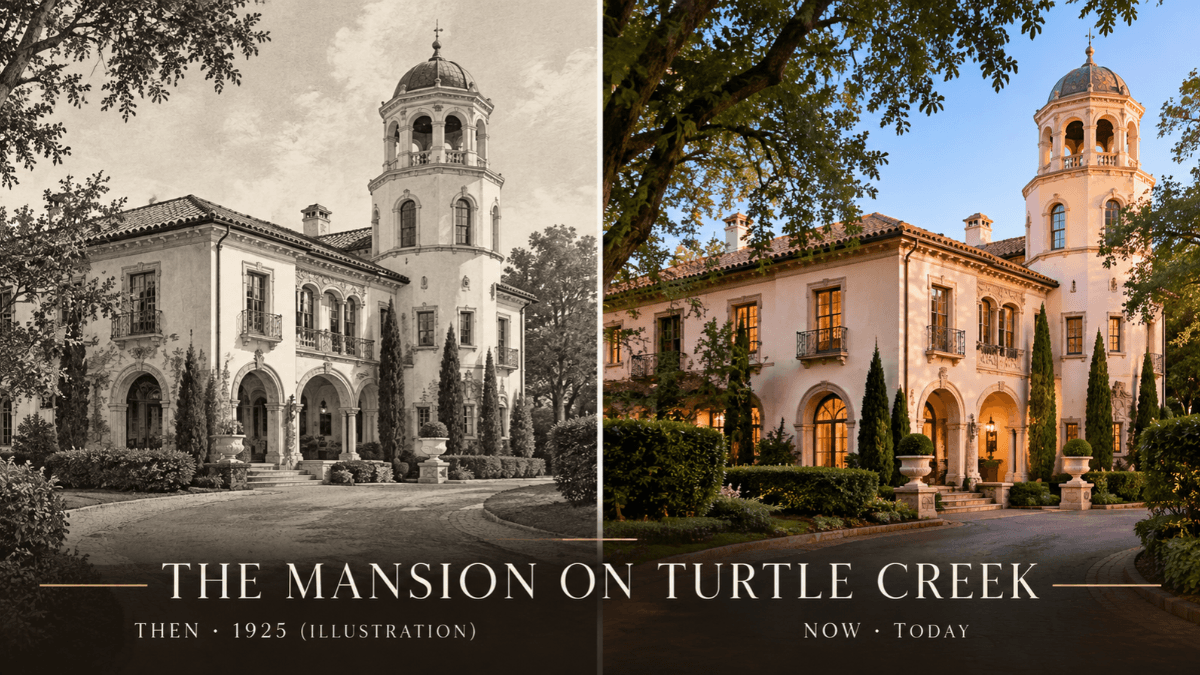
Built in 1925 for a Dallas cotton and oil magnate, the estate was part of a period when wealthy Dallas families were moving away from downtown and building European-inspired residences along Turtle Creek.
And here's where the story gets interesting.
The mansion we know today wasn't even the first mansion built on the property.
Apparently, one wasn't enough.
First, Meet Sheppard King: A Dallas Millionaire With Expensive Taste
To understand The Mansion, we have to go back to the early 1900s, when Dallas was growing rapidly and fortunes were being made in cotton, commerce and oil.
One of those fortunes belonged to Sheppard W. King.
King was a successful cotton broker whose business, King, Collie and Company, operated internationally, with offices in places including Liverpool, Milan and New Orleans.
He later expanded into the oil business.
By the early 1900s, King had the means to build an impressive residence in one of Dallas' emerging fashionable neighborhoods.
So, in 1908, he built a spacious Mission Revival-style home near Cedar Springs Road and Gillespie Street.
And for about fifteen years, that was apparently fine.
Until it wasn't.
In 1923, King decided the house no longer suited him.
His solution?
Tear it down and build something better.
Now, I see plenty of homeowners contemplating a renovation, an addition or an entirely different floor plan.
But demolishing your mansion because you've grown tired of it?
That's a different level of home improvement.
According to the City of Dallas' historic landmark documentation, King had the original house demolished while he, his wife and their architect spent two years traveling through Europe collecting furnishings for its replacement.
Not exactly a weekend trip to the furniture store.
By 1925, the new King Mansion was complete.
And Dallas had gained one of its most extraordinary private residences.
When Turtle Creek Was Dallas' Fashionable Escape
Here's something worth remembering.
When Sheppard King built his estate, Turtle Creek wasn't surrounded by the hotels, office towers, condominium buildings and busy streets we recognize today.
It was part of an evolving residential landscape attracting Dallas' wealthier families.
As the city grew, affluent residents began looking northward for larger properties, quieter surroundings and distance from downtown's industrial activity.
Early residential development along Turtle Creek and Cedar Springs was even promoted as being beyond the city's smoke and dust.
Which, when you think about it, is a remarkably early version of the same real estate pitch we still hear today.
More space.
A better setting.
A little separation from the bustle.
The details may change, but the motivations behind where people choose to live often remain surprisingly familiar.
Large estates began appearing along Turtle Creek, creating a fashionable residential environment that looked very different from the urban corridor we know today.
The King Mansion was among the grandest examples of that era.
And its location tells us something important about Dallas.
Long before Uptown became Uptown, this part of the city was already attracting people who wanted an exceptional address.
A Little European Grandeur in the Middle of Texas
If you're familiar with The Mansion's exterior, you already know it doesn't look like a typical Dallas house.
That's because typical wasn't exactly the goal.
The residence was designed with Italian Renaissance and Spanish Colonial influences, creating a distinctly European appearance.
The two-story historic structure features a tower, verandas, arcades and a formal patio.
Inside, the craftsmanship was equally impressive.
Decorative plasterwork, elaborate ceilings, stained glass and architectural detailing gave the home a sense of permanence and sophistication.
And some of those features survive today.
Rosewood highlights an ornamental ceiling created by artist Giovanni Primo Casci, a stained-glass window inspired by the Magna Carta, and the estate's original library.
Even the original vault remains part of the property, now incorporated into its hospitality experience.
Imagine building a home with architectural details so distinctive that, a century later, they remain part of the reason people want to visit.
That is what makes historic architecture fascinating to me.
Certain buildings were designed for more than immediate function.
They were designed to make an impression.
And sometimes, they continue making one long after the original owners are gone.
The Mansion Changes Hands, and Eventually Becomes an Office
Of course, even extraordinary homes don't stay in the same family forever.
In 1935, Sheppard King sold the property to another wealthy Dallas oilman, Freeman W. Buford, and his wife, Carolyn Shelly Buford.
The Bufords continued using the estate as a private residence until the late 1940s.
After that, the property's future began to change.
The once-grand family home was converted into office space.
For years, Wynne Oil Company operated there.
Eventually, Republic Financial Services acquired the property in the early 1970s.
Think about that transformation for a moment.
A house designed for entertaining wealthy Dallas society had become a place for desks, meetings and everyday business operations.
The elaborate rooms were still there.
The architectural details were still there.
But the building's original purpose was fading into history.
And by the late 1970s, its future was uncertain.
There were plans to demolish the old mansion.
Which means one of Dallas' most recognizable landmarks came remarkably close to disappearing.
And this is where another famous Dallas family enters the story.
Enter Caroline Rose Hunt: The Woman Who Saw Something Worth Saving
If the name Caroline Rose Hunt sounds familiar, it should.
She was the daughter of legendary Texas oilman H. L. Hunt and a successful businesswoman in her own right.
But by the late 1970s, she was about to become closely associated with something entirely different.
Luxury hospitality.
According to D Magazine's historical reporting, Caroline and her son Steve Sands became interested in the aging King Mansion after learning about plans to demolish it.
Rather than see the estate disappear, they imagined turning the historic residence into an elegant restaurant and bar, with a luxury hotel constructed alongside it.
In 1979, the newly established Rosewood Hotels acquired the property for approximately $1.6 million.
The project ultimately involved roughly $19.4 million more in renovation and hotel development.
That was quite an investment in a building many people might have considered obsolete.
But Hunt understood something important.
The mansion had something a brand-new hotel couldn't manufacture overnight.
History.
Character.
A sense of place.
The original residence would become the restaurant and gathering spaces, while a new nine-story hotel building was constructed beside it.
Instead of replacing the historic mansion, the development incorporated it.
And in 1981, The Mansion on Turtle Creek opened as a luxury hotel and restaurant.
A Dallas landmark had been given an entirely new life.
The Restaurant That Became Dallas Society Central
Now we get to one of my favorite parts of this story.
Because The Mansion didn't simply become a successful hotel.
It became a Dallas institution.
When the property opened in 1981, it did so with a lavish two-day celebration that attracted national media attention.
According to D Magazine, the opening festivities included 270 couples paying $1,000 each to attend.
In 1981.
Clearly, this was not your average hotel ribbon-cutting.
From the beginning, The Mansion became associated with Dallas society, business leaders, visiting celebrities and special occasions.
Its reputation was built as much around the experience as the accommodations.
The service.
The atmosphere.
The dining room.
The sense that simply being there was something of an event.
And then there was the food.
Chef Dean Fearing became one of the restaurant's defining figures, helping establish its reputation for innovative Southwestern cuisine.
During his more than two decades at The Mansion, Fearing became closely associated with a style of cooking that brought regional Texas flavors into the world of sophisticated fine dining.
The restaurant earned national recognition and became a destination for visitors and Dallas residents alike.
Its influence extended beyond the walls of the original estate.
It helped shape perceptions of what dining in Dallas could be.
For a city sometimes stereotyped by outsiders as little more than steaks and barbecue, that was a meaningful accomplishment.
Not that I have anything against a great steak.
Or barbecue.
Let's be reasonable.
Famous Guests, Dallas Power Brokers and the Art of Being Seen
Part of The Mansion's appeal was never just what happened in the kitchen.
It was who might be sitting at the next table.
Over the years, the hotel and restaurant developed a reputation for attracting celebrities, political figures, professional athletes, business leaders and prominent Dallas families.
A 1997 D Magazine feature described the property as a central gathering place for Dallas society.
The article captured something interesting about the restaurant's early identity.
For some guests, dinner at The Mansion was about exceptional food.
For others, it was also about being part of the scene.
The right room.
The right table.
The possibility of recognizing someone famous across the dining room.
Very old Dallas.
And perhaps a little amusing when viewed from today's perspective.
But that sense of occasion helped make the restaurant more than a place to eat.
It became part of the city's social history.
Think of the business deals, celebrations, anniversaries, conversations and connections that have taken place within those walls.
The building began as a gathering place for one wealthy Dallas family.
It eventually became a gathering place for generations of Dallas residents and visitors.
That's a pretty remarkable evolution.
The Mansion Today: Old Architecture, New Chapters
A century after the King residence was completed, The Mansion remains one of Dallas' most recognizable historic properties.
Today, it's known as Rosewood Mansion on Turtle Creek.
And while the property has undergone renovations and changes over the years, its historic identity remains central to the experience.
The original mansion still anchors the restaurant and gathering spaces.
Architectural details connect visitors to the building's earlier life.
The 1925 library remains part of the property's hospitality offerings, including afternoon tea.
The original vault has also been incorporated into the experience.
And the adjoining hotel continues the luxury hospitality tradition Caroline Rose Hunt established decades ago.
What I find particularly interesting is how the property's role has changed without completely losing its identity.
It began as a private estate.
Became offices.
Faced potential demolition.
Then emerged as one of Dallas' signature destinations.
Same historic building.
Very different chapters.
The Real Estate Lesson: Sometimes the Best Development Is the One That Saves Something
This is where The Mansion's story becomes especially relevant to real estate.
Because when we talk about development, we often focus on what's new.
New buildings.
New neighborhoods.
New commercial projects.
New opportunities.
And of course, cities need to evolve.
But The Mansion offers a wonderful example of something else.
Adaptive reuse.
Instead of demolishing a historic property and starting over, the owners found a way to give an existing building a new purpose.
And they didn't just preserve it as an architectural artifact.
They made it economically useful again.
That's an important distinction.
A building doesn't always have to serve its original purpose to remain valuable.
Sometimes its future depends on finding a creative new one.
As a REALTOR® who enjoys older homes, established neighborhoods and interesting properties, I love stories like this.
Because the question isn't always what could replace a building.
Sometimes the more interesting question is what the existing building could become.
The Mansion is a particularly glamorous example.
Most adaptive-reuse projects don't come with celebrity guests and elegant dining rooms.
But the principle still applies.
Good architecture, thoughtful investment and the right vision can give a property an entirely new chapter.
And sometimes, preserving the past becomes the smartest way to build the future.
Next Time You're at The Mansion, Look a Little Closer
Here's my suggestion.
The next time you're near Turtle Creek, take a moment to really look at the original mansion.
Not just the hotel entrance.
Not just the restaurant.
The house itself.
Look at the tower, the arcades, the exterior details and the way the older structure sits beside the hotel addition.
Imagine the property in 1925, when it was surrounded by a very different Dallas.
Imagine the private dinners and gatherings hosted by the King family.
Then picture the same rooms decades later, filled with office furniture.
And finally, consider how close the building came to being demolished before Caroline Rose Hunt helped give it a new purpose.
It's a reminder that some of Dallas' most interesting places aren't necessarily the newest.
They're the ones that have lived a few lives.
And The Mansion?
Well, it's had quite a few.
More Dallas: Then, Now & Next
This article is part of my Dallas: Then, Now & Next series, where we explore the places that shaped Dallas and North Texas, how they've changed over time, and what their future might hold.
From former shopping destinations like Valley View Mall and Collin Creek Mall to historic properties that found an entirely new purpose, these stories remind us that cities are constantly evolving.
Some places disappear.
Some are reinvented.
And every once in a while, something remarkable survives.
The Mansion on Turtle Creek is one of those stories.
Love Historic Homes, Dallas Architecture and Neighborhood Stories?
One of my favorite things about Dallas real estate is discovering the history behind the places we see every day.
Sometimes it's a grand estate.
Sometimes it's an overlooked commercial building.
And sometimes it's an ordinary house in an established neighborhood with far more character than anyone realizes.
I've been helping North Texas buyers, sellers, relocating clients and investors navigate real estate since 2000.
And whether you're drawn to historic architecture, a thoughtfully updated older home or a property with potential for its next chapter, I believe understanding a property's story can be just as valuable as understanding its numbers.
If you're thinking about buying, selling or investing in Dallas, Richardson, Plano, Addison or the surrounding North Texas communities, I'd love to help.

Kelly Reber, REALTOR® | eXp Realty LLC | Texas License #0483312
Licensed since 2000
Dallas | Richardson | Plano | Addison | North Dallas
Dallas native Kelly Reber has been helping buyers, sellers, relocating clients, and investors navigate North Dallas real estate since 2000. She combines deep local knowledge, data-driven strategy, and straightforward advice to help clients make confident real estate decisions.
Learn more: About Me
Categories
- All Blogs (143)
- Addison (1)
- Buyers (111)
- Dallas (15)
- Investors (46)
- Listings (2)
- McKinney (1)
- Plano (3)
- Richardson (12)
- Sellers (78)
- Series: Before it was North Dallas (8)
- Series: Dallas Day Trippin' (8)
- Series: Dallas Has a Story for That (1)
- Series: Dallas Neighborhoods to Watch (11)
- Series: Myth Monday (27)
- Series: RISD (7)
- Series: Then Now Next (1)
Recent Posts