Before It Was North Dallas: Part Seven: Before DART, There Was the Interurban
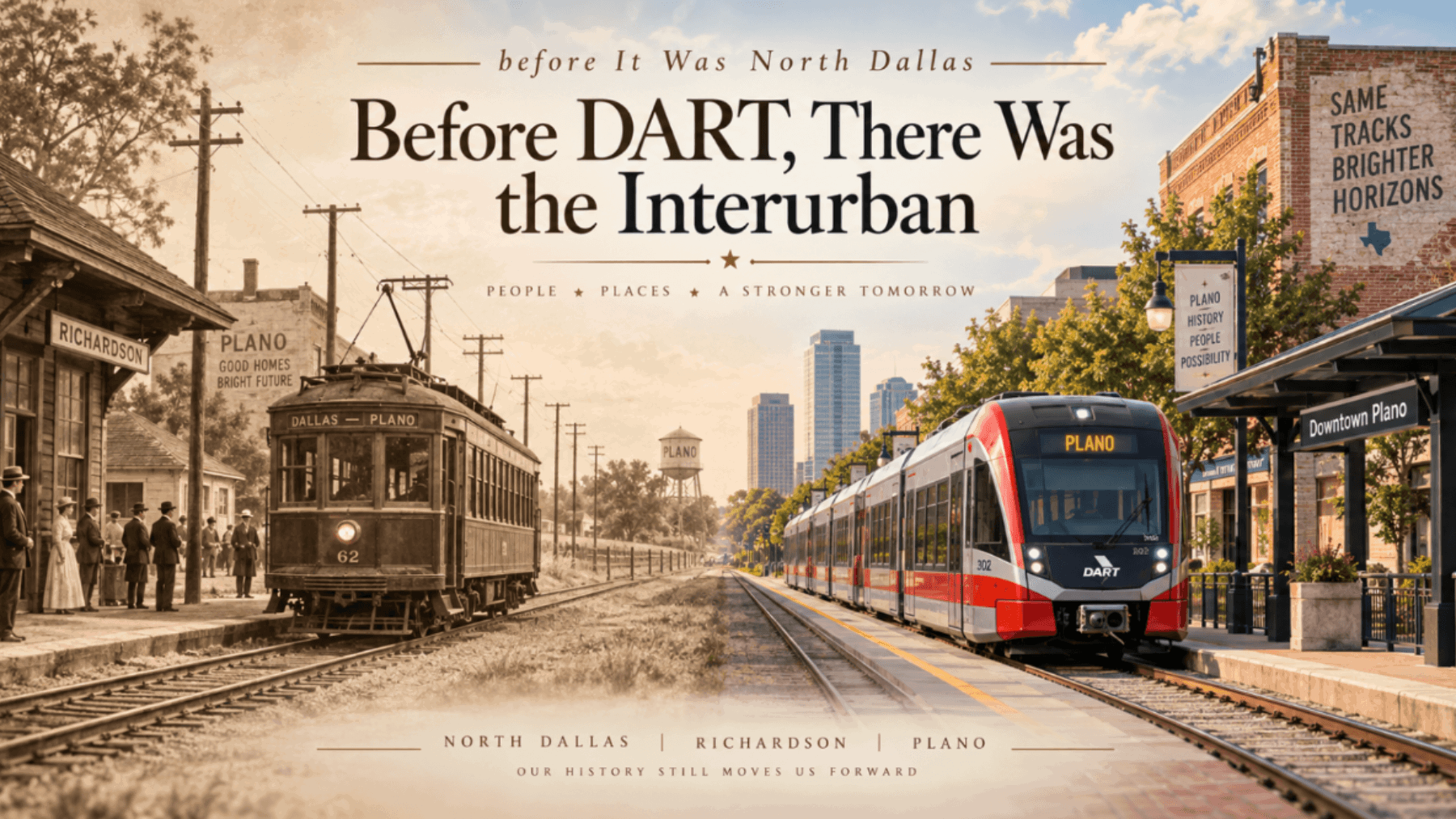
Before It Was North Dallas: Before DART, There Was the Interurban
Part Seven: Before DART, There Was the Interurban
Long before North Texans debated light rail routes, transit-oriented development or how close a home is to a DART station, people were already riding electric rail between Dallas, Richardson, Plano and other growing communities.
It was called the Interurban.
And for a few decades in the early 1900s, it changed the way people moved through North Texas.
Today, it is easy to think of regional rail as a modern idea. But more than 100 years ago, Richardson and Plano were already connected to Dallas by electric railway service. The Texas Traction Company built a 65-mile line from Dallas to Sherman in 1908, and in 1917, the Texas Traction Company and Southern Traction Company merged to form the Texas Electric Railway Company, which became the largest interurban railway in the South with more than 200 miles of track.
A Different Kind of Commute
Imagine living in early Richardson or Plano and being able to board an electric rail car to travel into Dallas.
No Central Expressway.
No traffic alerts.
No toll tags.
No “why is everyone braking for absolutely no reason?”
Just an electric rail line connecting small towns, farms, downtowns and growing commercial centers.
The Interurban helped people travel for work, shopping, school, business and social visits. It also carried mail and freight, making it more than a passenger convenience. It was part of the region’s economic infrastructure.
Richardson’s own historical overview notes that in 1908, the Interurban electric railway began service with connections north to Denison, south to Waco, southeast to Corsicana and west to Fort Worth.
That is a much bigger regional footprint than many people probably imagine when they think about old North Dallas.
Richardson’s Growth Followed the Rails
Richardson had already been shaped once by rail when the Houston & Texas Central Railway helped create the original townsite in the 1870s.
Then the Interurban added another layer.
The Texas State Historical Association notes that Richardson began experiencing faster growth after the Texas Traction Company’s electric interurban railway arrived in 1908, connecting Richardson with Dallas, Denison and other North Texas communities.
That detail matters.
Transportation access has always influenced real estate demand. In the early 1900s, the Interurban made Richardson more connected, more accessible and more attractive as a growing community outside Dallas.
Today, we might talk about commute routes, DART access, walkability or proximity to job centers.
Back then, the conversation was simpler but very similar:
Can people get where they need to go?
Plano’s Interurban Story Is Still Standing
One of the best places to see this history today is in Historic Downtown Plano.
The Interurban Railway Museum is located in the former Plano Station of the Texas Electric Railway at 901 E. 15th Street. The Plano Conservancy notes that the Texas Electric Railway operated from 1908 to 1948, and the historic station remains one of the most visible reminders of Plano’s early rail history.
The Texas Historical Commission marker for the Texas Electric Railway Station explains that the building was constructed in 1908 by the Texas Traction Company and served both passengers and freight customers on the company’s North Texas routes.
That makes the museum more than a cute historic stop.
It is a preserved piece of the transportation network that helped shape Plano’s development.
Outside the museum, Historic Car 360 gives visitors a tangible look at what Interurban travel once felt like. The museum’s own history describes Car 360 as part of the Texas Electric Railway story and a preserved artifact that helps visitors understand electric rail transportation in North Texas.
Before DART, Downtown Plano Already Had a Rail Identity
This is what makes the “before DART” connection so interesting.
Modern DART service did not create the idea of rail-connected Plano.
It revived it.
DART’s Red Line extension reached North Dallas and Richardson in July 2002 with seven new stations, including stations in Richardson. Later that year, on December 9, 2002, DART extended the Red Line to Bush Turnpike Station, Downtown Plano Station and Parker Road Station.
The Downtown Plano Station sits near the historic district, close to Haggard Park and the Interurban Railway Museum.
So when you are standing in Downtown Plano today, you are not just looking at a modern transit stop next to an old museum.
You are seeing two chapters of the same story.
One rail line connected early 20th-century towns.
Another helped reshape 21st-century mobility and downtown redevelopment.
Different trains. Same basic idea.
Access changes everything.
The Interurban Was Early Transit-Oriented Living
We often use newer language to describe old patterns.
Transit-oriented development sounds modern, but the instinct behind it is not new.
People have always wanted to live near access, commerce, community and connection.
The Interurban helped support that kind of development long before we used today’s planning language. Town centers, shops, homes and civic life grew around the places where people could gather and travel.
Downtown Plano’s historic fabric makes that especially easy to see. The station, the park, the surrounding streets and the later DART stop all reinforce the same idea: transportation is never just about transportation.
It shapes where people live.
It shapes where businesses open.
It shapes what land becomes valuable.
And over time, it shapes the identity of a place.
What We Lost and What We Kept
The Texas Electric Railway stopped operating in 1948.
By then, automobiles, highways and changing development patterns were transforming North Texas. Suburbs expanded outward. Roads became the dominant way people moved. The region increasingly organized itself around the car.
But not everything disappeared.
Plano kept its Interurban station.
Car 360 was preserved.
Richardson still carries the memory of its Interurban stop through local history and even the name of the Interurban District in the Richardson CORE area, where the city notes that Richardson became a stop on the Interurban in 1908 between Dallas, Sherman and Fort Worth.
These pieces remind us that the past is not always buried.
Sometimes it is sitting right beside a modern rail line, quietly explaining that we have been here before.
Before It Was North Dallas
Before North Dallas became a network of suburbs, highways, office parks and light rail stations, it was connected by tracks.
The Interurban helped link small towns to Dallas.
It gave people a way to move beyond the limits of horse, wagon and early automobiles.
It helped Richardson and Plano become more connected, more accessible and more woven into the larger North Texas story.
And it proves something we still see in real estate today:
People follow connection.
They did it in 1908.
They did it when DART expanded north in 2002.
They still do it every time they choose a home because of a commute, a school, a downtown, a trail, a highway or a rail station.
The transportation changes.
The principle does not.
What piece of North Dallas history do you think deserves to be remembered?
And here is your fun local-history challenge: next time you are in Downtown Plano, go stand near the DART station, walk over to the Interurban Railway Museum and look around. You are basically standing inside a “then and now” map of North Texas transportation. Bonus points if you send me a photo — I will happily nerd out over old rail lines, historic buildings and the neighborhoods that grew up around them.
Next in the series: We will stay with the transportation theme and look at the red brick road that helped change Richardson’s connection to Dallas.
💻 Read the whole Before it was North Dallas Series here
The tracks may have changed, but location and connection still matter. If you are considering a move in North Dallas, Richardson, Plano or the surrounding area, I can help you find the neighborhood that fits the way you want to live today. Reach out, let's chat!

Kelly Reber, REALTOR® | eXp Realty LLC | Texas License #0483312
Licensed since 2000
Dallas | Richardson | Plano | Addison | North Dallas
Dallas native Kelly Reber has been helping buyers, sellers, relocating clients, and investors navigate North Dallas real estate since 2000. She combines deep local knowledge, data-driven strategy, and straightforward advice to help clients make confident real estate decisions.
Learn more: About Me
Categories
- All Blogs (136)
- Addison (1)
- Buyers (105)
- Dallas (11)
- Investors (46)
- Listings (2)
- McKinney (1)
- Plano (3)
- Richardson (12)
- Sellers (73)
- Series: Before it was North Dallas (8)
- Series: Dallas Day Trippin' (7)
- Series: Dallas Has a Story for That (1)
- Series: Dallas Neighborhoods to Watch (10)
- Series: Myth Monday (24)
- Series: RISD (7)
- Series: Then Now Next (1)
Recent Posts