Before It Was North Dallas: Part Eight: The Red Brick Road That Changed Richardson
Before It Was North Dallas: Roads, Rails and the Shape of the Suburbs
Part Eight: The Red Brick Road That Changed Richardson
Before Central Expressway cut through the map, before DART stations connected commuters, and long before we were all arguing with our GPS in traffic, Richardson’s connection to Dallas depended on a road.
Not a highway.
Not a tollway.
A red brick road.
In 1924, the Red Brick Road, now known as Greenville Avenue, was completed through Richardson. According to the City of Richardson, the road brought an increase in traffic, population and property values.
That one sentence says a lot.
Because in real estate, then and now, access changes everything.
From Railroad Town to Road-Connected Suburb
If you have been following this chapter of Before It Was North Dallas, you already know Richardson’s earliest growth was shaped by the railroad.
The Houston & Texas Central Railway helped create the townsite in the 1870s, pulling people and businesses toward the depot and away from the earlier settlement of Breckinridge. Then, in 1908, the Interurban electric railway gave Richardson another transportation connection to Dallas and other North Texas communities.
But by the 1920s, another kind of movement was beginning to matter more.
The automobile.
The Red Brick Road gave Richardson a better connection to Dallas at a time when cars were becoming a bigger part of daily life. What had once been a small railroad town was starting to function more like a connected suburb.
That shift may sound ordinary now, but it was a major turning point.
A reliable road meant more people could travel between Richardson and Dallas. It meant businesses had more visibility. It meant land became more useful. It meant Richardson was no longer just a place along the tracks. It was a place people could reach by car.
Greenville Avenue Before It Was Greenville Avenue
The road we now know as Greenville Avenue has been part of North Texas movement for a long time.
The Texas State Historical Association notes that the Richardson Pike, present-day Greenville Avenue, connected Richardson to Dallas and was paved with red bricks in 1924, leading to increased automobile traffic into Richardson.
The old name matters.
“Richardson Pike” tells us how people understood the road. It was the way to Richardson. A route. A connector. A path between communities before the region was stitched together with modern highways.
Today, Greenville Avenue feels like a familiar urban and suburban corridor. It runs through Dallas neighborhoods, past restaurants and retail, and into Richardson’s historic core. But underneath all of that, it still carries the old story of how people moved north and south before Central Expressway became the dominant route.
A road name can become so familiar that we stop hearing it.
But this one still tells a story.
One Car, One Sidewalk and a Town About to Change
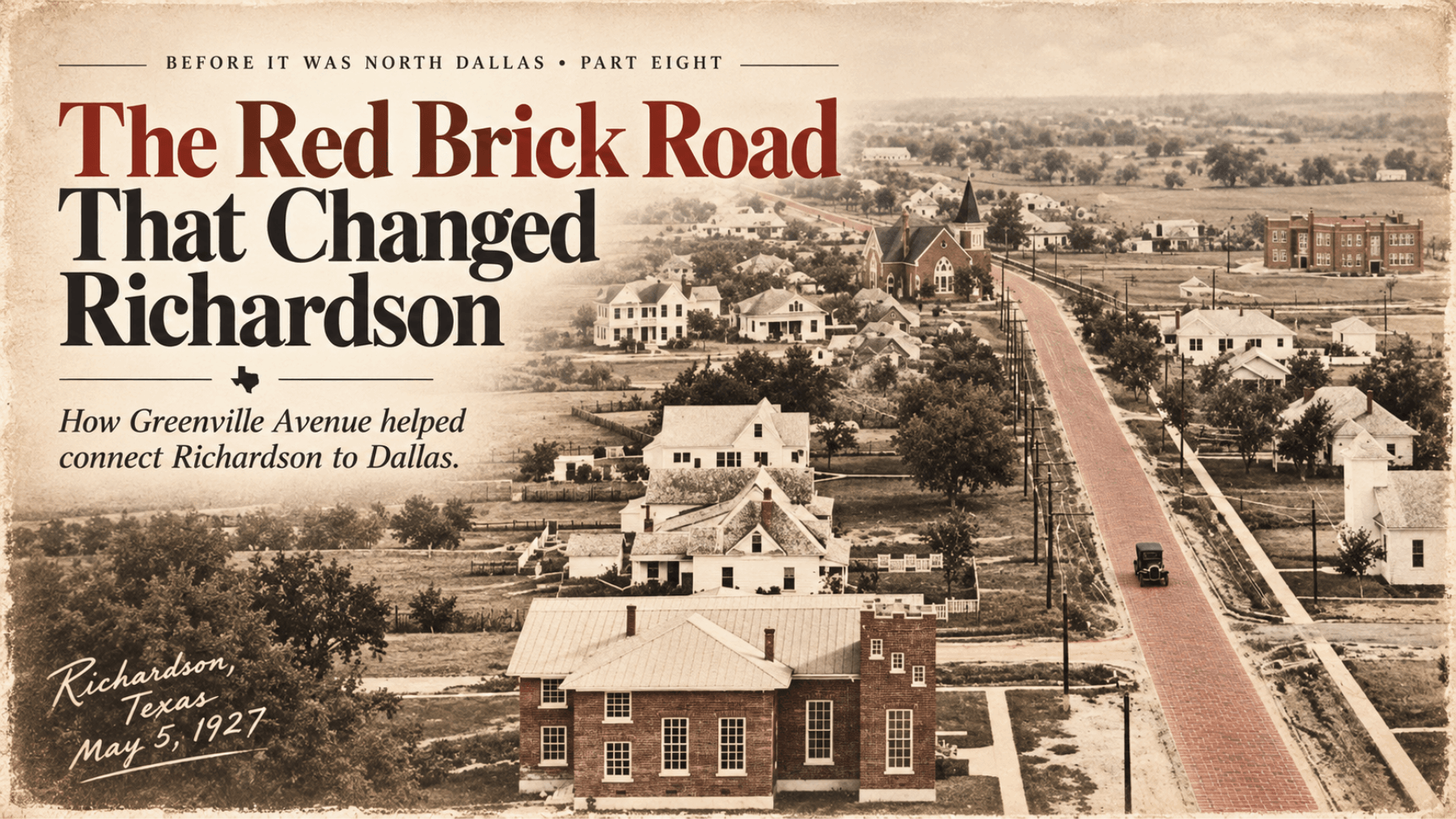
One of the best images for this post is a 1927 elevated view of Greenville Avenue in Richardson from The Portal to Texas History.
The photograph looks south, probably from Main Street. It shows one car on Greenville Avenue, a sidewalk along the west side, utility poles, churches, residences and the Richardson School building that opened in 1914. The photo was provided by the Richardson Public Library through The Portal to Texas History.
That detail is what makes the image so good.
One car.
A sidewalk.
A few buildings.
And a road that would help pull Richardson into its next chapter.
It is easy to look at today’s Greenville Avenue and only see traffic, businesses, aging commercial buildings and redevelopment potential. But in that 1927 image, you can see the transition happening. Richardson is still small, but it is no longer isolated.
The road is there.
The car is there.
The connection to Dallas is there.
The future is already on the pavement.
When Roads Change Real Estate
This is where local history and real estate start speaking the same language.
When access improves, property changes.
That was true when the railroad arrived. It was true when the Interurban connected Richardson and Plano to Dallas. It was true when the Red Brick Road made automobile travel easier. It would be true again when Central Expressway reached Richardson in 1954, helping accelerate postwar suburban growth.
Every major transportation improvement changes the way people think about location.
A home that once felt far from Dallas becomes convenient.
A farm road becomes a commercial corridor.
A town center becomes more visible.
A quiet area becomes attractive to builders, businesses and families.
The Red Brick Road did not just move cars. It moved Richardson closer to Dallas in the minds of buyers, business owners and residents.
That is the part of history that still matters today.
When people ask why one neighborhood grows faster than another, why values shift, or why certain corridors redevelop, the answer often starts with access.
Roads do not just connect places.
They help create value.
The Road to Incorporation
The timing of Richardson’s incorporation is worth noting.
Richardson incorporated in 1925, the year after the Red Brick Road was completed. The City of Richardson’s history connects the road’s completion to growth in traffic, population and property values, and the Texas State Historical Association notes that Richardson’s population had grown to more than 400 by 1925.
That does not mean the road alone created the city government, but it was clearly part of a larger moment.
Richardson was becoming more connected.
More people were arriving.
Property values were rising.
The small town needed to organize for the next phase of growth.
In other words, the Red Brick Road was not just a quaint detail from the past. It was part of the transition from rural railroad town to incorporated suburb.
Greenville Avenue Today
Today, Greenville Avenue is still one of Richardson’s most recognizable corridors.
It runs through the historic Main Street area and near the city’s CORE District, where Richardson has focused attention on redevelopment, walkability, small businesses and a more connected urban feel.
That makes the Red Brick Road story especially relevant now.
Richardson is not simply creating a new identity along Greenville and Main Street. It is building on a very old one.
The same corridor that once brought automobile traffic and new property value into Richardson is still part of the city’s future. It is still about access, visibility and connection.
Only now, the conversation includes redevelopment, adaptive reuse, restaurants, mixed-use projects, trails, DART access and how to make older commercial corridors feel alive again.
The red bricks may be gone from daily view, but the road’s influence is not.
Before It Was North Dallas
Before North Dallas became a web of suburbs, highways, rail lines, shopping centers and office parks, it was shaped by simpler but powerful connections.
A railroad helped create Richardson.
The Interurban linked early suburbs to Dallas.
And the Red Brick Road gave Richardson a stronger automobile connection at exactly the moment cars were beginning to reshape the region.
That is the theme running through this chapter of Before It Was North Dallas.
Transportation is never just about getting from one place to another.
It shapes where people settle.
It shapes what land becomes valuable.
It shapes where businesses open.
It shapes what cities become.
And sometimes, one old road explains a whole lot more than we realized.
What piece of North Dallas history do you think deserves to be remembered?
Here is your little local-history field trip: next time you are on Greenville Avenue in Richardson, slow down just enough to imagine it as the Red Brick Road. One car, one sidewalk, a few early buildings and a town about to grow up around access. Then look around and ask yourself what today’s roads, rail stops and redevelopment corridors are quietly shaping for the next generation.
If that kind of neighborhood story makes you see Richardson or North Dallas a little differently, you are my kind of person. Follow along for the next chapter of Before It Was North Dallas, and reach out anytime if you want to talk homes, history, location or the hidden stories behind the streets we drive every day.
Next in the series: We will head north to Plano and look at how a devastating downtown fire helped shape the historic brick storefronts people still love today.
💻 Read the whole Before it was North Dallas Series here
Need help buying or selling your next home, let's chat!

Kelly Reber, REALTOR® | eXp Realty LLC | Texas License #0483312
Licensed since 2000
Dallas | Richardson | Plano | Addison | North Dallas
Dallas native Kelly Reber has been helping buyers, sellers, relocating clients, and investors navigate North Dallas real estate since 2000. She combines deep local knowledge, data-driven strategy, and straightforward advice to help clients make confident real estate decisions.
Learn more: About Me
Categories
- All Blogs (139)
- Addison (1)
- Buyers (109)
- Dallas (13)
- Investors (46)
- Listings (2)
- McKinney (1)
- Plano (3)
- Richardson (12)
- Sellers (76)
- Series: Before it was North Dallas (8)
- Series: Dallas Day Trippin' (8)
- Series: Dallas Has a Story for That (1)
- Series: Dallas Neighborhoods to Watch (10)
- Series: Myth Monday (26)
- Series: RISD (7)
- Series: Then Now Next (1)
Recent Posts